
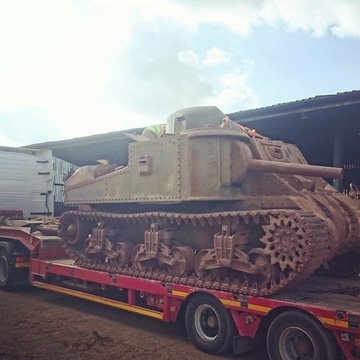
Our newest arrival has finally landed at Armourgeddon and we are delighted to tell you all about it. The arrival of the M3 Lee from Australia has been a very long time coming! Having been found for us by a specialist down-under, almost a year ago, the tank was purchased back in November 2017 along with a long list of parts. We were on the lookout for an M3, the predecessor to the M4 Sherman for a long time. To find one specifically in Australia with such an interesting history is perfect as an addition to the collection at Armourgeddon.
The M3 Lee, officially titled Medium Tank M3, was an American medium tank during World War II. Due to two different turret configurations, in the UK the M3 was known by 2 different names; Lee and Grant after the Confederate general Robert E. Lee for the US configured turrets and Grant after the Union general Ulysses S. Grant for the British pattern turrets.
As soon as design work was completed, and production commenced in 1941 on the M3, a large order, to plug the 3,650-tank shortfall in the British army, was placed. The design was compromised in order to get to production quickly- despite the considerable firepower and armour, the M3 had a high silhouette, an archaic mounting system for the main gun and poor off-road performance.
Nonetheless, with a 75mm main gun and a 37mm cannon on top, the M3 rolled off production and was into the theatres of war across the world by late 1941. Of course, the issues highlighted ahead of production, but ignored in desperation, became insurmountable and the M3 was soon withdrawn from combat as the M4 Sherman became available in larger numbers. Despite replacement elsewhere, the British army continued to use their M3s in combat against the Japanese in southeast Asia until 1945.
The design of the M3 was unusual, in the first instance, because the sponson mounted hull. The hull was offset, as an enclosure, projecting from the side, for visibility and to provide a layer of bulletproof protection for the gunner, as well as storage space. The sponson mount was necessary because, at that time, the American tank plants did not have the necessary experience to create a mount strong enough to hold a 75mm weapon. The 75mm gun was operated by a gunner and a loader. Sighting the gun used an M1 periscope with internal telescope, mounted on top of the sponson. The gun and periscope rotated together, sighting up to 2,700m with vertical markings to aid deflection shooting at moving targets.
Additionally, the tank was made with thicker armour than planned, which was riveted plates. The rivets had a tendency to pop off inside the tank, creating a deadly ricochet when the tank was hit by a non-penetrating round. The tanks had insufficient plating and a lack of splash-proofing on the jointed areas. Some areas of concern were addressed, and in total 1,250 M3s were ordered by the British Army at a cost of UD$240 million.
At the start of WWII, the Australian Army viewed tank units as minor additions to their attack strategy. However, by early 1941, the effectiveness of the German panzer attacks had changed opinion.
The 1stAustralian Armoured Division was formed to complement the three Australian infantry divisions, at that time, in North Africa. However, following the outbreak of hostilities with Japan, the division was retained in Australia. During April and May 1942, M3s were sent to re-equip the regiment, with training being carried out in Narrabri, New South Wales. As time went on, the Australian Army converted some M3s for special purposes; as bulldozers, beach armoured recovery vehicles and waders. Soon after the conclusion of the war, a small number of M3s were converted to a local, self-propelled gun design- the only self-propelled gun to ever be deployed by the Australian Army. Many of the remaining M3s were bought by civilian land owners, to be converted into earth moving equipment, tractors and logging vehicles.
According to our sources, this particular M3 was used for training exercises following its time in live battle against the Japanese. At the end of one such training mission, the M3 was left in a forest in the outback. Some 20 years later, the tank was re-discovered, started and driven out of that forest under its own steam! Clearly, the engine design was not lacking!
The M3 Lee which has arrived with us this week, after 8 months of transport and issues, will require significant restoration before it is housed in our museum. The gun was inches too long to fit into the container and required shortening – and although we expected that to require some fundamental re-engineering, our contacts down-under have done such a good job, we are considering leaving the gun in its present state- adding to its story! There are numerous original markings on the inside of the tank, which we will restore and maintain. The engine will require stripping, steam cleaning and re-building and the bodywork will require some TLC, although the condition of the tank is far higher than many that we take delivery of.
The M3 is on the list for restoration following the completion of the Sexton which is nearing its final stages. Watch this space to find out when this unusual design of a tank, having crossed from the opposite side of the globe, will be on show in the collection.
The museum is open every day from 9am – 5pm throughout our tank season, April – October. Tanks run on the tracks every Saturday, Sunday and selected Wednesdays and can be viewed from the museum or booked in advance to drive. In addition, visitors are able to book Archery, Air Rifles or other activities. Please call ahead for availability of these activities.