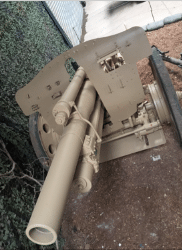
There are a wide variety of guns in the museum at Armourgeddon; some hand held riffles in our interactive exhibition and other artillery guns, some self-propelled, several which sit on the top and back of flat bed trucks, tanks and other military vehicles. The museum, open daily from 9am-5pm, is full of WWII memorabilia, tanks, military vehicles and even a Bell 47 helicopter. Entrance is £5 for anyone over 5 years old and free for under 5s and anybody on an experience at Armourgeddon. The perfect half term day out!
This week we thought we would share some details about a few of these artillery guns. First up, the Krupp 105mm Howitzer, then the 50mm Pak 38 and finally the Flak 38. Read on for all you need to know about thsee attacking forces of WWII.

The Krupp 10.5cm gun was an evolution of the WWI field guns by German engineers as they prepared for the battlefields of WWII. Sharing the same carriage as the 7.7cm FK16, significant developments were made following learnings from WWI trench warfare. These guns surrendered to Belgium as reparations after WWI were taken into Army service as the 10.5cm leFH following the Conquest of Belgium.
The mobility of the original 7.7cm FK96 was an attribute of this versatile gun until the war had settled into the trenches and its lack of range became a serious issue for the troops. The FK16 had a lengthened barrel and a box carriage added. Further increased elevation and range were the outputs of the Krupp 10.5cm. Separate loading ammunition to reduce powder consumption and barrel wear at short distance were also improvements with the new model; slower fire to re-load speeds were a negative output of these changes.
The Belgium Army modified many of the guns it received as post-war reparations into the Canon de 75 mile GP11 and GP111. The story of the Krupp 10.5cm mirrored that of the earlier incarnations of a Rheinmetall gun, originally the 10.5 Feidhaubitze 98- fixed recoil weapons delivered to the German Army as early as 1898.
The 10.5cm used three different types of ammunition and the aiming instruments were marked with three different metre scales and a dial sight for both direct and indirect fire. Originally using 7 charges of propellant, this was increased during the war effort to 8 to increase and extend range.
The Krupp 10.5cm in the Armourgeddon Museum is the standard divisional field gun used by the Werhmacht during WWII. The gun, also known as the 105H 33 was exported to Bulgaria in 1943 and 1944, purchased by the Swedish Army between 1939 and 43 and by Estonia, with the order to fulfilled between December 1940 and June 1941; an order not fulfilled due to the outbreak of WWII.

German forces first used the Pak 38 in April 1941 during WWII. When the Germans faced Soviet tanks in 1941 during operation Barbarossa, the Pak 38 was one of the few early guns capable of penetrating the 45mm armour of the T34 when quipped with Panzergranate 40 APCR shots with their tungsten core. This ammunition was used in an attempt to infiltrate the KV-1 tank. With it’s range and anti-tank capabilities, the Pak 38 was also used in the Atlantic Wall, capable of destroying Allied tanks on shore.
The Pak 38 remained in service with the Werhmacht through to the end of WWII, although surpassed in ability by more powerful weapons as the war effort continued. The gun’s carriage was also deployed to transport the 7.5cm Pak 97/38 and the 7.5cm Pak 50 (f) guns. Imported by the Romanian armed forces and remaining in use until 1954 when it was replaced by the 57mm anti-tank gun M1943 (ZiS-2).

The FlaK 38 anti-aircraft gun used by the Nazi Germany in WWII was introduced as a competitor to the 8.8cm FlaK 18. Proving too heavy for field use whilst having roughly similar performance to the 88mm, the FlaK38 use used primarily I static mounts. In the museum at Armourgeddon, the FlaK28 is mounted onto the back of a Citroen U23R flat bed truck. The German Navy deployed multiple pairs of these guns mounted on electronically powered tri-axial mounting, intended to compensate for the motion of the ship and maintain a lock into the intended target. Designed with hydropneumatic recoil and a horizontal semi-automatic sliding block breech, by Rheinmetall in 1933, approximately 4,200 FlaK38s were made.
The FlaK38 increased the rate of fire of its predecessors to 220 rpm and slightly lowered overall weight to 420 kg. The Flak 38 was accepted as the standard Army gun in 1939, and by the Kriegsmarine as the C/38.
Visit these guns and many more in our interactive museum, on site at Armourgeddon. Open from 9am-5pm every day, the museum charges are £5 per person, with under 5s and those booked onto an Armourgeddon activity able to visit free of charge.